
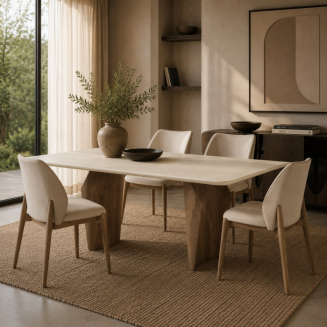
A dining table is where everyday meals turn into long conversations, where children finish homework, and where friends stay a little longer after dinner. That is why choosing the right size matters. A table should bring people together without making the room feel crowded.
This dining table size guide for UAE homeowners will help you choose a table for four, six, eight, or ten people. It also looks at the space around the table, the room shape, and the chairs you want to use with it.
The best dining room is one that feels inviting from the moment you walk in. Your table may be the centerpiece, but there should still be room to pull out a chair, serve a meal, and move around comfortably.
Key Takeaways
- Choose a table size based on the people you seat most often, rather than only the largest gathering you host occasionally.
- Measure the room before choosing a table, as the space around the table is just as important as the table itself.
- Leave around 90 cm behind dining chairs as a comfortable starting point, allowing more space for busy walkways.
- Round tables can make compact rooms easier to move through, while rectangular tables often suit longer rooms and larger guest lists.
- Check the full table size and allow for the chairs when planning your final dining room layout.
Start With the Way You Dine
Before looking at sizes, think about the meals that happen in your home. Do you usually sit down as a family of four? Do you enjoy having friends over on weekends? Is the dining area part of an open living room, or does it have its own room?
A table for four may be all you need for weekday breakfasts and quiet dinners. A six-seater gives you more space for family meals and a few guests. An eight- or 10-seater can be a beautiful choice for a larger dining room, especially if gatherings are a regular part of life.
The best table is not always the biggest one. It is the one that suits your routine and leaves the room feeling open. A dining room should feel ready for people, not filled from wall to wall with furniture.

Standard Dining Table Dimensions at a Glance
There are no single standard dining table dimensions for every home. The shape of the table, the base, the chair style, and the amount of elbow room you prefer can all change the final size. Still, these ranges are useful starting points when you begin planning.
| Seats | Rectangular Table: Common Starting Size | Round Table: Common Starting Size | Best Suited For |
|---|---|---|---|
| 4 | 120–150 cm long × 75–90 cm wide | 100–120 cm diameter | Apartments, breakfast areas, and smaller dining rooms |
| 6 | 160–200 cm long × 90–100 cm wide | 130–150 cm diameter | Family dining rooms and regular entertaining |
| 8 | 220–260 cm long × 100–110 cm wide | 160–180 cm diameter | Larger rooms and frequent gatherings |
| 10 | 280–320 cm long × 100–110 cm wide | 180–200 cm diameter | Spacious dining rooms, villas, and larger dinner parties |
Think of these dimensions as planning ranges, not fixed rules. A table with a pedestal base can make seating more flexible. Wide upholstered chairs need more room than slim dining chairs. An extendable table may also be a good choice when you want a smaller everyday layout with extra space for guests.
What Size Dining Table Do You Need?
A Four-Seater: Small Gatherings, Everyday Ease
A four-seater dining table is a lovely choice for a compact apartment, a breakfast corner, or a home where most meals are shared by two to four people. A rectangular table around 120 to 150 cm long usually gives everyone enough personal space, while a round table around 100 to 120 cm across can make the seating feel more relaxed.
Round tables work especially well when the dining area is close to the living room or kitchen. There are no sharp corners to walk around, and everyone at the table can see one another easily. If you prefer a longer layout, a rectangular table can sit neatly along a wall or in a narrow dining space.
Browse Al Huzaifa’s 4–6 seater dining tables when you want a dining piece that feels welcoming without taking over the room.
A Six-Seater: Room for Family and Friends
If you are wondering how much space for a 6-seater dining table is enough, start with both the table size and the chair movement around it. A rectangular table around 160 to 200 cm long is often a comfortable range for six people. For a round layout, look at a table around 130 to 150 cm in diameter.
A six-seater is often the sweet spot for family homes. It gives you room for everyday meals, but it also feels ready when friends visit for dinner. In an open-plan home, make sure the chairs can pull back without blocking the path to the kitchen or living area.
You can explore 6–8 seater dining tables if you want a little more flexibility around the table.
An Eight-Seater: Made for a More Generous Dining Room
For an eight-seater, you need a dining room that can accommodate the table as well as the space around it. A rectangular table is usually around 220 to 260 cm long, while a round table may be around 160 to 180 cm in diameter.
When thinking about how much space for an 8-seater dining table, do not stop at the table edge. Picture eight chairs pulled back after dinner. Think about someone carrying a serving dish from the kitchen, or a guest walking behind the chairs to reach their seat. If the room still feels easy to move through, the size is working.
An 8–10 seater dining table can become a warm focal point in a larger dining room. It gives everyone a place at the table without making the setting feel too formal.
A Ten-Seater: For Larger Homes and Longer Evenings

A 10-seater dining table is best for a spacious room where entertaining is part of everyday life. A rectangular table is often around 280 to 320 cm long. A round table needs a generous amount of floor space, but it can create a wonderful sense of connection when everyone is gathered around it.
In a villa dining room, a longer table can look striking beneath a statement ceiling light or beside a sideboard. However, the room should still have breathing space. If a 10-seater leaves no room to walk comfortably, a smaller table with an extension may suit your home better.
For larger gatherings, see Al Huzaifa’s 10–12 seater dining tables. A complete dining table set can also make it easier to plan the table and chairs together.
A Dining Table Clearance Guide for Everyday Comfort
A table may fit inside a room on paper and still feel too large once the chairs are in place. That is why a dining table clearance guide should always include the chairs, not only the tabletop.
As a comfortable starting point, leave around 90 cm from the edge of the table to a wall, cabinet, or other furniture. This gives someone enough space to pull back a chair and move behind it. If the space is a main route through the home, such as a path to the kitchen, balcony, or living room, aim for closer to 120 cm when the room allows it.
You may be able to work with less space in a compact dining area, but try the layout before you decide. Mark the table footprint on the floor with masking tape. Then mark the chairs pulled back. Walk around the outline as though you are serving a meal or sitting down with guests. This small test tells you much more than a measurement alone.
Also look at the chair shape. Dining chairs with arms, wide backs, or deep upholstered seats can need more room than a slimmer chair. If you are choosing the chairs separately, keep their width and depth close while you plan. Explore Al Huzaifa’s dining chairs after you have a clear idea of the table size and the space available around it.
Round or Rectangular: Which Shape Fits Your Room?
Both shapes can work beautifully. The right one depends on the room and the way you want it to feel.
A round table is often a good choice for smaller rooms or square dining areas. It has no corners, so the space can feel easier to move through. It also creates a more connected setting, since everyone faces toward the center. A round table for four or six can make casual meals feel warm and relaxed.
A rectangular table usually suits a longer room. It can seat more people along its sides and gives you a classic dining layout for family meals and special occasions. If your dining room is narrow, a rectangular table may use the shape of the room more naturally than a large round one.

A square table can also work in a square room for four people, but it needs more floor space as the seating capacity grows. Before deciding, look at the table shape together with the chair layout, the nearest door, and the main walkway through the room.
If a round layout feels right for your home, browse round dining tables. The goal is not to follow a strict rule. It is to choose a shape that makes the room feel easy to use.
How to Measure Your Dining Room
Measuring your dining room takes only a few minutes, but it can save you from choosing a table that feels too large once it arrives. Begin with a tape measure, a notebook or phone, and a clear idea of where you would like the table to sit.
First, measure the full length and width of the room. Then note anything that takes up space or affects movement, such as doors, door swings, windows, columns, sideboards, balconies, and open routes to another room.
Next, decide how much clearance you want around the table. If you are using 90 cm on each side, take 180 cm away from the room width and length. The remaining area gives you a helpful guide to the maximum table footprint. For a route used often, allow a little more where you can.

For example, if your dining room is 400 cm wide and you want 90 cm on both sides of the table, you have around 220 cm left for the table width. That does not mean you have to fill every centimeter. A slightly smaller table may make the room feel much more comfortable.
Finally, mark the outline of the table and chairs on the floor. Make sure doors still open, cabinets can still be used, and people can move from one room to another without turning sideways. Once the space feels right, you can browse dining tables with more confidence.
Frequently Asked Questions
For four people, look at a rectangular table around 120 to 150 cm long or a round table around 100 to 120 cm in diameter. The right size depends on the chairs you choose and the space around the table. If your dining area is compact, a round table can make it easier to move around the room while still giving everyone a comfortable place to sit.
A six-seater rectangular table is often around 160 to 200 cm long. For eight people, look at around 220 to 260 cm. A 10-seater usually needs around 280 to 320 cm. Round tables need more width in the room, but they can work beautifully when the dining space is more square than long. Always check the full room layout, including the chairs pulled back, before deciding.
Around 90 cm behind the chairs is a good place to start. It gives enough space to pull a chair back and walk behind someone who is seated. If the area is a busy route to the kitchen, balcony, or another room, closer to 120 cm can make daily movement much easier. The room should feel comfortable during a quiet meal and when the table is full.
A round table can be better for a smaller or square room because it has no corners and keeps the flow around it more open. A rectangular table may be better in a narrow room because it follows the room’s longer shape. There is no single answer for every home, so measure the room and mark the table shape on the floor before you choose.
Measure the full length and width of the room first. Then measure doors, door swings, windows, cabinets, and the paths people use to walk through the space. Subtract the clearance you want around the table from the room dimensions, then mark the table and chairs on the floor with masking tape. It is a simple way to see if the layout will feel comfortable before you buy.
Find a Dining Table That Feels Right at Home
The right dining table should feel generous when people are gathered around it and easy to live with when the meal is over. Whether you choose a round table for a cozy apartment, a six-seater for family dinners, or a larger table for long evenings with friends, the space around it matters just as much as the table itself.
Take your measurements with you when you browse. When the size, shape, chairs, and room flow all work together, your dining area becomes a place people naturally want to sit, share, and stay a while.